

Ladies and Gentlemen, I am back.
My BGC (blood gravy content) is 0.75. The Chicago Bears are 9-3 (Ben Johnson deserves a Nobel Peace Prize).
Life is good. I hope you had a fantastic Thanksgiving.
You’re reading this because I made the decision to defer my next CMT exam until the next cycle. I’ll take the test next summer instead — had a little too much on my plate through the end of this year.
A lot has happened since my November hiatus began, but today I only have one thing to talk about (since ~35% of my net-worth is held in this stock). This is has been a hot topic, and I am far from being the only person talking about it.
TLDR; You do not own enough Google.
Important AI Update — Google TPUs

The first real threat to Nvidia
On Tuesday, reports hit the tape stating that Meta is in talks to spend billions on Google’s AI chips, renting TPU capacity from Google Cloud as soon as next year and potentially buying TPUs for its own data centers starting around 2027.
Meta is one of Nvidia’s largest customers, with projected AI-related capex in the tens of billions of dollars. If even a slice of that budget moves to TPUs, Google and manufacturing partner Broadcom suddenly have a line of sight to a sizable chunk of Nvidia’s data center revenue base. Early estimates suggest a Meta deal alone could ultimately divert on the order of ~10% of Nvidia’s annual AI revenue into TPU-based systems. This is significant and something to keep an eye on.
The market reacted exactly how you’d expect to a major potential platform shift. Alphabet rallied (adding to an already strong move after its Gemini 3 launch), Broadcom gained, and Nvidia sold off ~3–4% on the day as investors digested the idea that one of its showcase hyperscaler customers was shopping for an alternative.
That move came on top of an earlier shock in October, when Anthropic announced plans to access up to one million TPUs worth “tens of billions” of dollars and more than a gigawatt of power to train and serve its Claude models. Combine that with Google’s early-November launch of TPUv7 “Ironwood” into general availability — its first TPU generation built explicitly for large-scale inference and external customers — and you get the theme for this week: the market is abruptly waking up to the idea that AI compute is drifting from a single-supplier Nvidia story toward an emerging Nvidia + Alphabet duopoly at the high end.
Probably 5% of you reading know even what a TPU is, so let’s fix that.
WTF is a TPU
A TPU (Tensor Processing Unit) is Google’s house chip for AI — a custom accelerator specifically tuned for the dense matrix multiplication that drives modern neural networks. A GPU is a general-purpose workhorse that can do graphics, simulation, and AI. A TPU is a narrower tool designed to do one thing very fast and very cheap: multiply giant matrices over and over again.
Google actually started down this path a very long time ago. Around 2013, internal capacity planning exercises showed that deploying AI at the scale they wanted (search, ads, maps, and YouTube recommendations) would effectively require they double their data center fleet if they were to stay on generic CPUs and GPUs. Instead of just eating all that capex, they started a custom silicon and systems program that led to the first TPU deployments back in 2016. Each generation since then has been paired with tightly co-designed racks, networking (Google’s ICI interconnect), and compiler/runtime (XLA and JAX) so that the whole stack behaves like one big matrix engine rather than a loose cluster of chips. The most recent generation, TPUv7 “Ironwood,” is now the workhorse for Gemini 3 and the anchor of Google’s external TPU offering.
The important mental model for investors isn’t simply comparing “TPU vs. GPU” — it’s “TPU system vs. Nvidia system.” In AI, capex and opex are dominated by accelerators, networks, and power, not developers. The hardware and systems stack you choose largely determines your cost per unit of compute, and that cost per compute unit is what governs margins and pricing power in AI-heavy products.
Being able to sufficiently minimize hardware costs is a massive edge, and one that every hyperscaler is looking to have.
TPUs have been here for over 10 years — so what?
For most of the past decade, TPUs have been an internal advantage for Google with a small, somewhat experimental presence in its cloud. The Anthropic partnership is the first real signal that Google is willing to let others sit on its silicon in a serious way. Even there, though, almost everything runs through bespoke deals and a short list of highly technical customers. This is still a tightly controlled rollout, not an open catalogue product, yet.
The more ambitious idea — Google as a full-blown chip merchant — is still mostly speculative, but very feasible (inevitable, in my opinion). Reports that Meta is exploring TPUs for future data centers, alongside its existing Nvidia footprint, suggests large buyers are actively shopping for a second source. Supply-chain checks and Google’s own comments around its latest Ironwood generation point in the same direction. There is real intent, but no clear commitment yet to sell TPUs broadly the way Nvidia sells its systems today. For now, the external footprint is concentrated in a handful of frontier labs that have both the engineering talent and the bargaining power to justify custom arrangements.
The underlying pressure, and the reason this matters for us, is that the market is likely to force Google’s hand. If TPUs genuinely offer lower cost per unit of compute and Google wants its cloud margins to move closer to its peers, keeping that hardware locked up as an internal-only advantage becomes harder for them to justify. Large customers want cheaper, more diversified compute. Shareholders want the economics of Google’s silicon to show up in reported profits and backlog. Google can try to move slowly, but once the cost and performance gap is visible, the combination of customer demand and investor expectations will keep nudging it from “secret weapon” toward “openly sold platform.”
We can game out Google’s decision tree cleanly — there’s three paths:
Keep TPUs fully in-house as a proprietary edge.
Rent them only through Google Cloud, keeping everything tied to Google-owned data centers.
Lean into being a selective merchant vendor — shipping TPUs into neoclouds, sovereign projects, and even rival hyperscalers like Meta.
Option one already looks dead. The Anthropic deal, Fluidstack franchise model, and Meta headlines are all evidence that TPUs have already escaped the lab. Option two (the pure cloud route) preserves recurring revenue but also locks Google into decades-long power and data center build-outs that investors are already nervous about. Option three is where this gets interesting. Selling TPUs into third-party sites lets Google capture chip margin and ecosystem share without owning every building and substation. In a world where stocks get punished every six months for higher capex, shifting part of the AI bet from “utility-like infrastructure” to “high-margin merchant silicon” makes Google structurally harder to kill.
It’s likely that the decision has effectively already been made. Once you start backstopping miner-hosted TPU sites and pitching TPUs to Meta, you have one foot firmly in the merchant camp. At that point the choice isn’t “sell or don’t sell,” it’s how fast you admit that this is a product line and not just internal plumbing.
Anthropic is an existing proof-of-concept
In rough terms per their October announcement:
Anthropic will deploy around 1 million Ironwood chips over the next few years.
About 400,000 of those are purchased systems, worth on the order of $10 billion in finished racks co-designed by Google and Broadcom and installed by neocloud provider Fluidstack in facilities owned by power-rich miners like TeraWulf and Cipher Mining. Read that again — we’ll come back to this shortly.
The remaining ~600,000 TPUs are rented from Google Cloud, with an estimated ~$42 billion of remaining performance obligations tied to that rental pool.
That structure matters because it shows TPUs are escaping Google’s four walls. Anthropic is simultaneously:
Renting TPUs directly from Google Cloud, and
Running its own TPU clusters in third-party data centers, with miners supplying power and space and a neocloud handling operations.
This is what turns Google into a merchant hardware vendor in practice. A customer can buy TPU systems, deploy them in their own or third-party sites, and also burst into the cloud when needed — exactly the pattern that has made Nvidia’s DGX systems so central to the GPU ecosystem. The Meta rumors look very similar, with some capacity rented from Google Cloud, some capacity eventually purchased and installed in Meta’s own data centers.
Layered on top is a new financing innovation for miners and neoclouds. GPU or TPU clusters are reported to have 4–5 year useful lives (the actual useful lifespan is a massive debate among investors right now — I could write an entire post on this alone), while data center leases run 15+ years with ~8-year payback. This duration mismatch has historically made it hard to finance new facilities for smaller clouds.
If you hate shady AI financing then I know you’re going to love this. We’ll call it the “Hyperscaler IOU.”
The Hyperscaler IOU
Google’s workaround is a credit backstop: an off-balance-sheet commitment to step in if a partner like Fluidstack can’t pay its data center rent. The Hyperscaler IOU de-risks the project for landlords and lenders and I believe it will quietly become a standard template in the emerging TPU hosting market.
Normally, a big data center project only gets financed if a creditworthy tenant (Amazon, Microsoft, Google) signs a long lease directly with the landlord. The bank underwrites the project on the back of that tenant’s balance sheet.
In this TPU setup, Google doesn’t want to sign all those leases itself. Instead, you get this chain:
Miner / data center owner: controls land and power (legacy crypto sites).
Neocloud (Fluidstack): signs the lease, does the build-out, operates the machines.
Google: provides the TPUs and cloud relationship… and then quietly signs a side agreement saying, in effect:
“If Fluidstack ever can’t pay the rent, we’ll step in and take over the contract / capacity.”
That side agreement is the credit backstop. It’s not booked as Google’s capex — it’s a contingent obligation. But from the landlord’s and lender’s perspective, it looks a lot like having Google in the deal anyway. Their real risk is now “Google eventually takes this over” rather than “random startup defaults and we’re stuck holding an empty building.”
The net effect:
The miner and neocloud look more financeable (cheaper debt, more projects approved).
Google gets future capacity without putting all the real estate and power on its own balance sheet.
Everyone can pretend their capital intensity is lower than it really is.
This makes miners & neoclouds attractive sources of exposure to the TPU trade. They’re essentially being turned into levered real-asset wrappers on Google’s AI expansion, with Google quietly acting like a guarantor in the background.
The catch is that this IOU model also makes Google’s risk profile harder to read. On paper, the data center lease sits with a miner or a small cloud provider. In substance, everyone involved is assuming that Google will step in if things go wrong. That creates a layer of off-balance-sheet exposure that doesn’t show up in capex lines or headline leverage ratios, but still ties Google to the underlying project. Investors see the upside of TPU backlog — they do not see (in one place) the contingent (and possibly very expensive) promises that helped make that backlog financeable.
It’s the familiar problem of complexity. Instead of one clear lease between a hyperscaler cloud and a landlord, you now have miners, specialty clouds, lenders, and “shadow guarantees” stitched together around each site (dry-gagging as I write this).
You can even argue it creates a moral hazard. If miners and neoclouds know a hyperscaler is standing behind them, they have more incentive to push projects to the edge of what the market will bear. Google gets capacity without booking the full cost, but it also absorbs some of the tail risk if the cycle turns.
For now, the IOU is a clever way to accelerate TPU deployment. Over time, it’s a place where regulators, ratings agencies, and investors should pay closer attention to how much obligation has quietly been written in the background.
Why labs care — TCO, utilization, and negotiation power
From the vantage point of Anthropic, Meta, or OpenAI, the question isn’t,
Is Ironwood a nice chip?
It’s,
What’s my cost per effective FLOP? And how much leverage does that give me with Nvidia?
Quick jargon detour. A FLOP (floating point operation) is the smallest unit of math these chips really care about — one multiply or multiply-add in the matrix soup that makes up a neural net. TFLOPs or PFLOPs are simply scaling that up:
TFLOPs = trillions of FLOPs per second (raw speed).
PFLOPs = quadrillions of FLOPs (total “amount of math” done over a training run).
So when I say, “cost per effective FLOP” or “per effective PFLOP,” I’m really asking:
How many dollars do I spend for each unit of useful math the system actually delivers, after all the bottlenecks and inefficiencies?
On internal economics, SemiAnalysis’ modeling suggests that in a full TPUv7 deployment:
Google’s total cost of ownership (TCO) per TPUv7 in its 3D-torus configuration is roughly 40–45% lower than the TCO of a comparable Nvidia GB200 server, even after conceding a modest shortfall in peak FLOPs and bandwidth.
Once Google layers on cloud margin and leases capacity to customers, TPUs can still price out ~30% cheaper than GB200 and ~40% cheaper than GB300 on an apples-to-apples, effective-performance basis.
The wrinkle is Model FLOP Utilization (MFU) — how much of the theoretical math throughput you actually use in a real training run. Nvidia’s headline TFLOPs are calculated at aggressive clocks under ideal conditions. Real-world jobs bump into power limits, synchronization overhead, and less friendly tensor shapes. A sizeable chunk of peak performance never shows up in the logs. Because Google co-designs chip, rack, interconnect, and compiler, it can often push TPU MFU higher for its own workloads than a generic GPU cluster can.
Dylan’s numbers are again useful as a sanity check:
For Google’s internal training, TPUs roughly break even with GB300 on cost per effective FLOP if they hit about half the MFU that Nvidia hits on paper (for example, TPU at ~15% MFU vs GB300 at ~30%).
If Google’s compiler and systems teams can drive TPU MFU into the ~40% range, the cost per effective training FLOP could be on the order of 60% lower than an equivalent GB300 configuration.
Anthropic’s picture is similar but shifted by Google’s margin. Using a rough contracted price of $1.60 per TPU-hour on its rented TPUs and assuming serious optimization effort (they’ve hired ex-DeepMind/TPU compiler engineers), SemiAnalysis estimates they can still end up with ~50% lower TCO per effective PFLOP than a GB300 NVL72 system, with breakeven at an MFU of around 19%. For a lab that is willing to invest engineering effort in TPUs, the economics look meaningfully better than sticking solely with Nvidia.
Even for labs that never ship a TPU workload, TPUs are already doing work as a pricing lever. You can argue that OpenAI, simply by entertaining TPUs and other custom silicon, has already negotiated roughly 30% lower effective costs on its Nvidia fleet.
The exact number is less important. What is important, is that once Google’s stack is credible at scale, no one has to accept Nvidia’s list prices as a given. Everything becomes negotiable.
Software: Nvidia’s last big moat
The one edge Nvidia still owns outright is software. Their platform, CUDA, is the default environment for most AI work today. If you are a researcher, an open-source maintainer, or a startup building with AI, odds are your code is written and tuned first for Nvidia chips, then maybe adapted to everything else later.
TPUs have lived in a different world. Inside Google, they are wrapped in polished internal tools and tightly wired into Google’s own machine-learning stack. Outside Google, the experience has been rougher. Developers who live in common frameworks like PyTorch have had to jump through extra hoops to make their models run well on TPUs, and many simply haven’t bothered.
Google is now trying to close that gap. It is building a more “native” path for PyTorch users so that code written for Nvidia chips can target TPUs with far fewer changes. It is putting real engineering effort behind the main open-source inference stacks, and contributing its own optimized building blocks so they run better on TPU hardware. It is also standing up new tools that make it easier for advanced teams to write custom kernels for TPUs in the same way they already do for Nvidia.
All of this is early. Public benchmarks on TPUs still lag what Google and Anthropic see on their private stacks, and for the average developer, TPUs are still more work than GPUs. Google has noticed this, and is now measuring its TPU teams on how well they serve outside customers, not just internal research groups.
It seems most analyst criticism is that Google still holds the deepest layers too tightly. The low-level compiler, the TPU runtime, the networking code and the software that stitches very large clusters together are still closed and poorly documented. The argument is if Google were to open-source these pieces, TPU adoption would likely accelerate the same way it did for Linux and PyTorch when those ecosystems were opened to the world. Until that happens, CUDA will remain the default, and TPUs will be strongest in places where Google or a handful of very technical labs are willing to carry more of the load themselves.
What this means for Alphabet, Nvidia, and OpenAI
For Alphabet, this week is a line in the sand. Google no longer just “has a nice in-house chip.” It now clearly sits alongside Nvidia as a second platform for high-end AI compute. Gemini 3, trained entirely on TPUs, shows that Google can deliver frontier models on its own silicon — something OpenAI has failed to do since 2024 (GPT-4o). The Anthropic deal and the emerging Meta talks show that other top-tier labs are willing to build their roadmaps on that same hardware. If the cost math we walked through holds anywhere close to true, TPUs give Google Cloud a structural cost edge over clouds that only rent Nvidia. That edge can be spent either as higher margins or lower prices and more share. Either way, it supports a cleaner story of Google Cloud as a differentiated AI infrastructure provider rather than a permanent third place.
For Nvidia, none of this ends the GPU story. The company still has the richest ecosystem, the most flexible hardware, and decades-deep relationships across the big clouds and specialist hosting firms. The shift is more subtle. Nvidia moves from “uncontested king” to incumbent in a slow-forming duopoly. Revenue should remain strong. Margins should remain high by normal standards. But the days of total pricing freedom are likely behind it, and Nvidia will have to justify its premium against a visible, credible alternative in TPUs when their biggest buyers sit down to negotiate.
For OpenAI, TPUs are less of a lifeline and more of a constraint. Its moat so far has been simple: best-in-class models plus privileged access to the largest Nvidia footprint via Microsoft. Now it faces a world where Google has a competitive model, runs it on its own chips, and is willing to share those chips with rivals like Anthropic and possibly Meta. OpenAI can try to adopt TPUs and diversify its compute base, but that means leaning into a rival’s platform. It can double down on Nvidia and Microsoft, but that leaves it more exposed to a hardware and infrastructure stack it does not control. In this cycle, whoever owns the most efficient compute stack owns a disproportionate share of the economics. After this week, that power is no longer Nvidia’s alone.
Sorry, it’s still not a bubble
In my last market update on November 4, I said very clearly that I thought AI was becoming the next Manhattan Project, with direct government support — not because there’s money to be made, but simply because of the geopolitical consequences of not doing it. You can read below:

Low and behold, on November 24, the White House signed an executive order launching the Genesis Mission — a national AI program that the order itself describes as “comparable in urgency and ambition to the Manhattan Project,” led by the Department of Energy and its national labs.
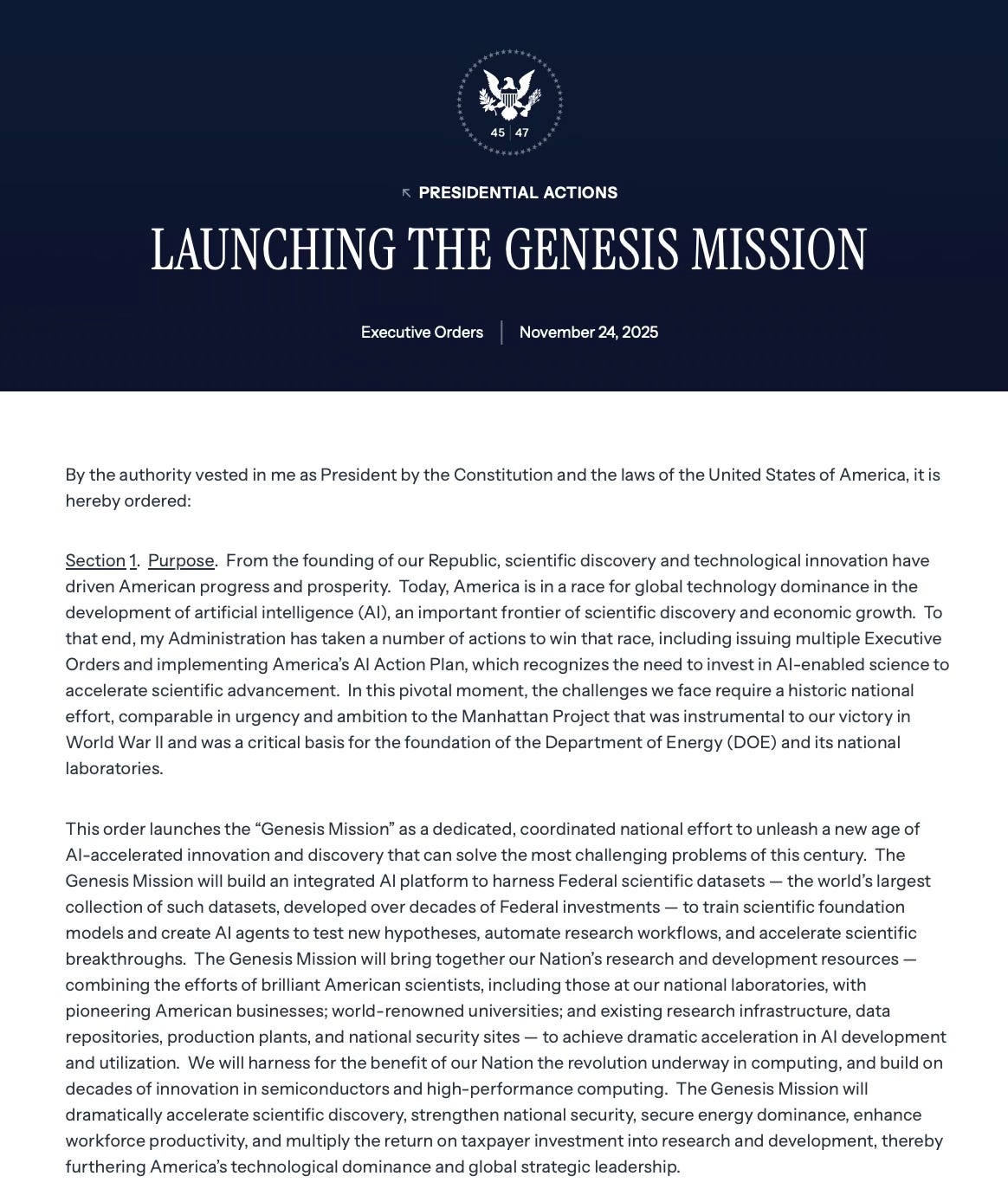
It directs DOE to stand up a unified AI platform on top of federal scientific datasets and supercomputers, with public-private partnerships to push breakthroughs in energy, biotech, materials, and national security.
For our purposes, it’s confirmation that AI is no longer just a private capex arms race; it is now explicit U.S. industrial-defense policy, framed in Manhattan-Project terms, and it’s the macro backdrop for everything you just read in this note.
While there are obviously many places within the larger AI Trade that I wouldn’t touch with a 10 ft stick — the main AI Trade is not going anywhere.